


Mithras and Jesus: Why the “Borrowed Pagan Myth” Theory Collapses Under Historical Scrutiny

Updated: Mar 14
Few claims circulate more confidently in atheist internet sub-culture than this one: Christianity copied its ideas from the pagan mystery religion of Mithraism.
Jesus, we’re told, is a recycled sun-god—born of a virgin, worshipped on December 25, surrounded by twelve disciples, offering a dying-and-rising saviour myth lifted straight from Mithras.
The problem with this is none of it survives contact with the actual evidence.
In this article, three questions will be asked and answers.
What does the best archaeological and textual sources on Mithraism say it actually was?
Why do scholars today reject the online claims Christianity borrowed these ideas?
Why did this theory emerge in the nineteenth century and why it has been abandoned by specialists for over a century?
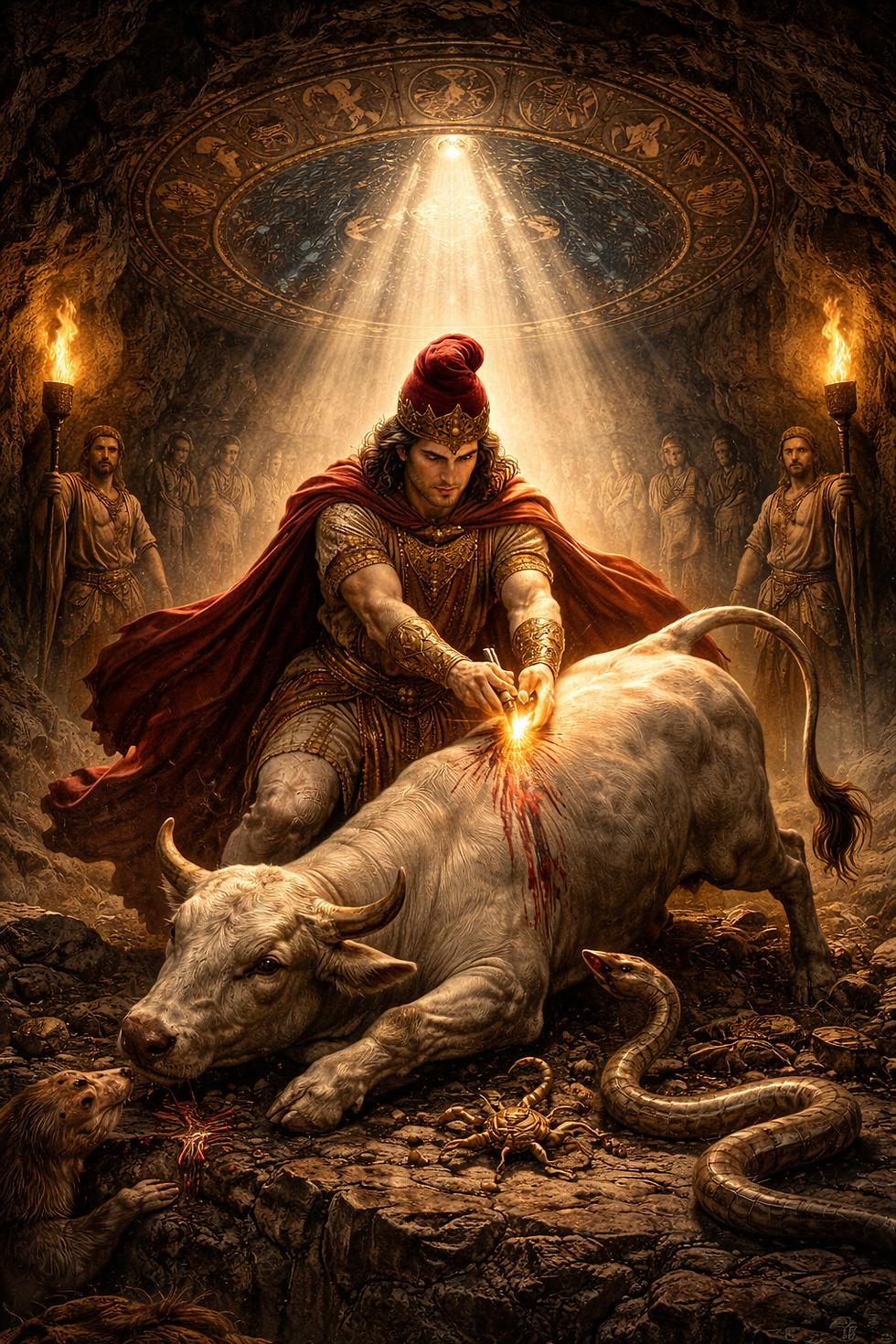
What Was Mithraism?
Roman Mithraism flourished primarily between the late first and fourth centuries AD, spreading throughout the Roman Empire, especially among soldiers, imperial administrators, and merchant networks. It was not an eastern religion transplanted intact into the Roman world, but a distinctly
Roman mystery cult—one that developed its own ritual life, symbolic language, and internal hierarchy, even while borrowing the name Mithras from an Iranian deity associated with covenant and light.
Our knowledge of Mithraism is necessarily indirect. Unlike Christianity, it produced no scriptures, theological treatises, or narrative accounts of its founder. Everything we know comes from material remains: underground shrines known as mithraea, dedicatory inscriptions, and reliefs—most famously those depicting Mithras slaying a bull in the central scene known as the tauroctony. These sources give us fragments rather than a storyline, symbols rather than sermons, and ritual practice rather than historical memory.
This distinction matters. Because Mithraism was initiatory and secretive, its meaning was communicated primarily through imagery and ritual performance, not through public proclamation or historical narration. As a result, modern scholars can describe Mithraism’s structure and symbolism with some confidence, even while acknowledging uncertainty about its deeper theological interpretation.
As Roger Beck, one of the foremost authorities on Mithraism, cautions:
“Roman Mithraism was not a survival of Iranian religion, but a new religious movement created within the Roman world.”²
What the archaeological and epigraphic evidence does allow us to say is relatively clear. Mithras is typically depicted as emerging fully formed from a rock (petra genetrix), rather than being born into history. The cult’s central symbolic act is the slaying of the bull, a scene whose cosmological or astrological meaning continues to be debated but which bears no resemblance to a dying-and-rising savior myth. Initiates advanced through seven graded levels, often associated with the planetary spheres, suggesting an interest in cosmic order rather than historical redemption. The cult was exclusively male, deliberately secretive, and structured around communal meals and ritual progression rather than moral teaching or public ethics.
Crucially, Mithraism offers no narrative biography of Mithras—no teachings, no parables, no historical setting, and no account of suffering, death, or resurrection. Mithras is a timeless figure of mythic action, not a first-century Jewish teacher remembered, debated, and interpreted within living historical memory.
These features do not merely distinguish Mithraism from Christianity; they make the idea of Christian dependence historically implausible. The two movements operate in different symbolic worlds, serve different social functions, and relate to history in fundamentally different ways.
Common Internet Claims—and Why They’re Wrong
Let’s take the most common claims one by one.
Claim 1: Mithras Was Born of a Virgin
False. Mithras is consistently depicted emerging fully grown from a rock. No ancient source describes a virgin birth, sexual or asexual.
Edwin Yamauchi notes:
“There is no virgin birth in Mithraism—this is a modern fabrication.”⁴
Claim 2: Mithras Was Born on December 25
Unsubstantiated. December 25 appears centuries later in Roman solar festivals. No Mithraic text or inscription associates Mithras’ birth with that date.
Even Bart Ehrman—no defender of Christian orthodoxy—writes:
“There is no evidence that Mithras was born on December 25.”⁵
Christian use of December 25, where it occurs, is tied to Roman calendrical symbolism, not Mithraic myth.
Claim 3: Mithras Had Twelve Disciples
Invented. Some reliefs depict twelve zodiac symbols. These are not disciples, not followers, and not human companions.
Roger Beck again:
“The zodiac does not represent disciples of Mithras. The idea is entirely modern.”⁶
Claim 4: Mithraism Had a Eucharist Copied by Christians
Mithraic meals did exist—but ritual meals are nearly universal in ancient religion. No evidence links them to Jesus’ Last Supper.
Larry Hurtado explains:
“Shared meals are not evidence of borrowing; they are a basic feature of ancient cultic life.”⁷
More importantly, Christian Eucharistic theology appears in Paul’s letters by the 50s AD, decades before Mithraism spread widely.
Claim 5: Mithras Was a Dying-and-Rising Savior
Mithras does not die. He does not rise. There is no passion narrative.
Manfred Clauss summarizes bluntly:
“Mithras is not a dying and rising god, and there is no myth recounting his death.”³
That point alone collapses most internet comparisons.
Two Fundamental Errors
Refuting individual claims of pagan borrowing is necessary, but it does not address the deeper problem. The persistence of these arguments rests on two foundational errors—errors so basic that, once exposed, the entire edifice collapses.
The first is the assumption that similarity implies dependence. This mistake has long been recognized by historians of religion. Jonathan Z. Smith memorably warned that comparison, when improperly handled, becomes an exercise in illusion rather than explanation:
“Similarity is not identity, and resemblance does not prove dependence.”⁸
Religions operating in the same cultural world will inevitably share symbolic vocabulary—light, meals, initiation, salvation. But without evidence of direct contact, transmission, and adaptation, resemblance explains nothing. To move from “this looks similar” to “this was borrowed” is not historical reasoning; it is assertion.
The second error is even more decisive: the neglect of chronology.
The earliest evidence for Jesus of Nazareth comes from Paul’s letters, written within twenty to thirty years of Jesus’ death (c. AD 50–60), followed by the Gospels, composed between roughly AD 65 and 90. These texts are early, abundant, and explicitly concerned with preserving historical memory, however theologically interpreted.
By contrast, the best archaeological and epigraphic evidence for Roman Mithraism points overwhelmingly to its expansion in the late first and second centuries AD. Its growth occurs after Christianity was already established, spreading publicly through texts, preaching, and communities across the Mediterranean. Mithraism, by contrast, spread quietly through small initiatory cells, left no theological literature, and communicated meaning through symbol rather than proclamation.
Chronology alone reverses the popular narrative. If influence occurred at all, it could not have flowed in the direction internet mythicism assumes.
As Manfred Clauss concludes:
“Where influence occurred, it is more plausible that Mithraism absorbed elements from Christianity, not the other way around.”⁹
Once similarity is distinguished from dependence, and chronology is taken seriously, the claim that Christianity borrowed its central beliefs from Mithraism dissolves. What remains is not a historical argument, but the lingering afterlife of an outdated theory—repeated long after the reasons for abandoning it have been firmly established.
Why the Mythicist Theory Arose (and Died)
The idea that Christianity emerged by borrowing pagan myths—particularly from mystery cults like Mithraism—originated in the nineteenth century, within the emerging field of comparative religion. Scholars such as James Frazer and, more influentially for Mithraism, Franz Cumont, worked with limited evidence and a prevailing evolutionary model of religion that assumed myths naturally developed from primitive forms to more advanced ones.
Given what was known at the time, some of these proposals were not irrational. Archaeology was still in its infancy, few Mithraic sites had been excavated systematically, inscriptions were poorly catalogued, and Roman Mithraism was widely assumed to be a direct continuation of ancient Persian religion simply because the name Mithra appeared in Iranian texts. Chronology was often inferred rather than demonstrated.
However, both methodological flaws and new evidence soon exposed the weakness of this approach.
Methodologically, nineteenth-century comparativists tended to flatten religious differences, assuming that surface similarities implied genetic dependence. They frequently ignored social and historical context, treated religions as collections of interchangeable myths, and underestimated the distinctive character of Second Temple Judaism. Jonathan Z. Smith would later label this habit parallelomania: the tendency to draw comparisons without demonstrating historical connection or causal mechanism.
More decisively, archaeological and epigraphic discoveries in the twentieth century overturned the historical foundation of the theory. As mithraea were excavated across the Roman Empire—at Ostia, Dura-Europos, along the Rhine and Danube—clear patterns emerged. Almost all securely dated Mithraic material belongs to the late first through third centuries AD. Inscriptions show Mithraism flourishing primarily among Roman soldiers well after Christianity was already established.
Equally important, advances in Iranian studies demonstrated that Roman Mithraism was not a faithful continuation of Persian religion. The Roman cult preserved the name Mithras and some imagery, but not the theology, mythology, or ethical framework of Iranian Mithra worship. The assumed ancient lineage simply collapsed under scrutiny.
As a result, the older “borrowed mythology” models were quietly but firmly abandoned by specialists. Edwin Yamauchi summarizes the consensus succinctly:
“The old ‘borrowed mythology’ theories have been abandoned by specialists for over a century.”¹⁰
What survives today is not a live scholarly debate but a fossilized argument—preserved largely in internet atheist subcultures, long after the academy has moved on. The claim that Jesus is a patchwork of Mithraic mythology persists online precisely because it is insulated from peer review.
By contrast, Christianity is intelligible only within the world that produced it: Second Temple Judaism. When the evidence for Mithraism is examined on its own terms, it lacks a dying-and-rising savior, a resurrection proclamation, an ethical teaching tradition, and an identifiable historical founder. It does not explain Jesus; it postdates him.
What the comparison ultimately reveals is not Christianity’s weakness, but the enduring appeal of parallelomania—the habit of mistaking superficial resemblance for historical explanation. That habit belongs to speculative nineteenth-century theory and modern conspiracy culture, not to responsible historical scholarship. By and large, historians have matured and moved on.
Footnotes
Manfred Clauss, The Roman Cult of Mithras (Edinburgh: Edinburgh University Press, 2000), 3–5.
Roger Beck, The Religion of the Mithras Cult in the Roman Empire (Oxford: Oxford University Press, 2006), 17.
Clauss, Roman Cult of Mithras, 62.
Edwin Yamauchi, Pre-Christian Gnosticism (Grand Rapids: Eerdmans, 1973), 112.
Bart D. Ehrman, Did Jesus Exist? (New York: HarperOne, 2012), 229.
Beck, Religion of the Mithras Cult, 33.
Larry Hurtado, Lord Jesus Christ (Grand Rapids: Eerdmans, 2003), 136.
Jonathan Z. Smith, Drudgery Divine (Chicago: University of Chicago Press, 1990), 52.
Clauss, Roman Cult of Mithras, 168.
Yamauchi, Pre-Christian Gnosticism, 15.


Comments