


The Markan Passion Narrative and the Case for an Ultra-Early Source

The Markan Passion Narrative—the account of Jesus' final hours in the Gospel of Mark (chapters 14–15)—stands out in New Testament studies. Most scholars agree it's the earliest-formed section of Mark's Gospel, drawing on traditions older than the rest of the book. A stronger, more debated claim holds that this narrative comes from a source written extremely early—within about 7 years of Jesus' crucifixion (around AD 30–33), likely by the mid-30s AD.
This isn't wild speculation or fringe theory. It's built on solid, converging lines of evidence from language, history, and social context. No single point seals the deal alone, but together they create a strong cumulative case. Even scholars who push back on the ultra-early date often admit the Passion account sits remarkably close to the events.
Here are the top three or four reasons that make the strongest, most straightforward case for an ultra-early source.
1. The Unnamed “High Priest” – A Time-Stamp Clue
In Mark's Passion story, the figure who oversees Jesus' trial is called simply “the high priest” (Mark 14:53, 60, 63)—no name given. We know from history and other Gospels (like Matthew and John) that this was Caiaphas, who served as high priest from AD 18 to 37.
Rudolf Pesch highlighted this odd detail decades ago. If the story were written or finalized after Caiaphas left office in 37, the writer (or tradition) would probably have clarified “Caiaphas” or “the former high priest” to avoid confusion—especially since high priests changed frequently. Instead, the reference assumes everyone knows exactly who is meant, like saying “the President” today during a term in office, rather than “President Biden” years later.
This points to a tradition that crystallized while Caiaphas was still in power—placing it no later than AD 37, just a handful of years after the crucifixion. It's a simple linguistic and historical inference about how people talk about current public figures.
2. Protective Anonymity – Hiding People Still at Risk
Several characters in the Passion account are left strangely nameless, even though their actions are dramatic:
The disciple who strikes the high priest's servant with a sword (Mark 14:47)—later identified as Peter in John.
The young man who flees naked when arrested (Mark 14:51–52).
Gerd Theissen proposed these omissions aren't sloppy writing. They reflect “protective anonymity.” In the tense years right after Jesus' death, naming certain followers who clashed with authorities could endanger them or their families. The high priest's circle (including Caiaphas' relatives) stayed influential for decades, so discretion made sense.This kind of caution fits a very early Palestinian context—likely Jerusalem in the 30s—when memories were fresh, some participants were still alive, and political danger lingered. Later retellings (in Matthew, Luke, John) feel safer naming names.
3. Named Eyewitness Anchors – People Who Could Be Checked
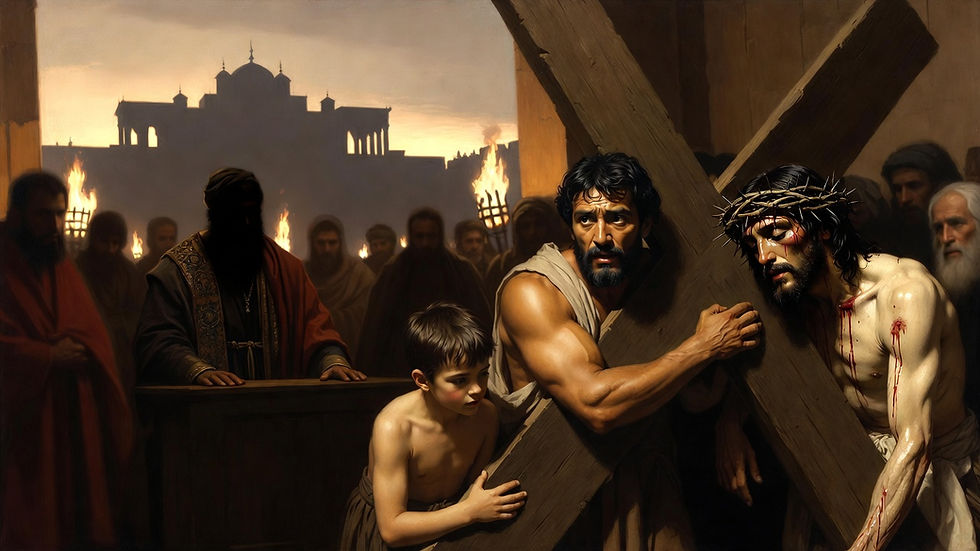
In contrast to the anonymity above, Mark unusually names secondary figures like Simon of Cyrene, the man forced to carry Jesus' cross, and even mentions his sons Alexander and Rufus (Mark 15:21). Richard Bauckham argues this isn't random. In ancient texts, naming otherwise minor people often signals living witnesses known to the community—people who could confirm the story if questioned. Mentioning the sons implies the original audience in Mark's circle might recognize them (perhaps members of the church), turning the detail into a kind of embedded “footnote” to eyewitness testimony.This naming pattern suggests the tradition circulated in a setting where these individuals were still around and known—not decades later when they'd be forgotten or irrelevant.
4. Tight, Continuous Structure + Lack of Later Theological Polish
Unlike much of the Gospels, which string together short, independent episodes (sayings, healings, disputes), the Passion narrative flows as one continuous, self-contained story—from arrest through trial, crucifixion, and burial. Form critics long noted this as evidence of a pre-existing written or fixed oral source that Mark incorporated largely intact. Adding weight: the account shows little theological elaboration. There's no developed atonement doctrine, no heavy resurrection theology (Mark's original ending stops abruptly at the empty tomb in 16:8), and no smoothing of awkward details.
It includes “embarrassing” elements that later writers might sanitize: disciples fleeing, Peter denying Jesus, women as key witnesses. These raw, unpolished features fit an early stage—before decades of reflection and doctrinal development turned the story more interpretive.
Taken together, these points—the unnamed high priest as a timestamp, protective anonymity as a sociological marker, named anchors pointing to living witnesses, and the narrative's primitive, continuous form—converge on one conclusion: the core of Mark's Passion account likely stems from a source composed shockingly close to the events, within a decade or less.
This doesn't prove every detail is historical, but it does mean the Passion tradition is among the closest ancient accounts we have to the events they describe—far closer than most ancient biographies or histories are to their subjects.
Scholars continue to debate the exact dating and shape of any pre-Markan source, but the evidence demands that even skeptics take the early horizon seriously. The story of Jesus' death wasn't shaped over generations of myth-making; it bears the marks of living memory from the very first circle of followers.


Comments